BollingerAÿ, Grande Vallée
Producer profile
PL Founded in 1829, Bollinger is Aÿ's most prominent champagne house and one of the most renowned. A blanc de noirs called Vieilles Vignes Françaises is a "powerful, full-flavored champagne of singular personality" that delivers a "pungent expression of pinot noir" from two "intriguing" plots of ungrafted pinot noir vines. These vines are cultivated in the traditional method of provignage that "involves burying the principal shoot of the vine into the ground, which then forms a new vine connected to the old one." Grande Année is "one of the region's most famous prestige cuvées, and with the version called R.D., the house pioneered the idea of late-released vintages with extended lees aging." Grande Année Rosé is "superb", and a portion of its red component pinot noir is bottled as a still red Coteaux Champenois called La Côte aux Enfants, "a rich, mouth-filling wine marked by ripe fruit" named after the famous 4-hectare Aÿ vineyard. TyS 10/10 second largest independent family-owned house (after Roederer) producing "ravishing champagnes that rank among the very best of the region." House mandate is to use "as little sulphur dioxide preservative as possible." "The monumental stature of Bollinger's cuvées derives from several key facets: estate-grown vineyards centered around Aÿ; blends built on pinot noir, barrel fermentation, deep reserves, long lees maturation and ageing under cork." It's a "champagne of cathedral proportions: towering, impacting, and magnificent." Bollinger has been nicknamed "The Burgundy house" because of the key role of the estate-grown pinot noir in its cuvées, "minimum of 60%" in each. 68% of total pinot noir used is from estate vineyards. 180 hectares with 85% grand cru. Vintage wines are 100% barrel-fermented. "Infused with the resilience of barrel maturation, Bollinger's white cuvées possess propensity for great longevity (but its rosés are best drunk as youthful as possible)." "Special Cuvée is blessed with astonishing depth of reserves, up to 60%." The reserve wines are aged in magnums under cork, not under crown seal, a practice not followed by any other sizeable house. 85K reserve magnums are manually opened and checked by 10 workers over 3 weeks for production of Special Cuvée and Rosé. Systematic malo. 2 million bottles of Special Cuvée are produced each year with 3 disgorgement dates. Disgorgement is not indicated but can be deciphered from the neck and cork stamps, refer to page 143 for details. Bollinger bottle shape is worth noting, it was introduced in 2012 and features a wider base and narrower neck to approximate a magnum with the aim to slow ageing in bottle. "The complexity and richness of Special Cuvée is unparalleled among the entry non-vintage blends of every champagne house." ToS 93 "value". "Bollinger's rich, oak-aged and Pinot dominant style has its dedicated fans." It was Lily Bollinger who "took the decision to stick to oak barrels" when most houses in Champagne were "changing to inox vats in the 1960s and 1970s." "All vintage and reserve wines are born in barrels, as are a significant part of the wines destined for the Special Cuvée. Bollinger uses very old barrels: the oldest of their 3,000+ barrels have reached the respectable age of 110 years. The highly oxidative impact of such old oak combined with long 6-7 month barrel-ageing times accounts for Bollinger's deliberately oxidized, bruised apple and earthy-spicy style." "The entire range, excluding R.D. and Vieilles Vignes Françaises, represent true value for money." "Bollinger tends to go toasty rather than biscuity, due to the influence of oak rather than Chardonnay, which plays a relatively minor role. There is a huge difference between Bollinger's non-vintage and vintage styles." "At least half of the wines used for the Special Cuvée are cask fermented, making it one of the most complex non-vintage Champagnes on the market, with a lean, austere, acidic, even unforgiving character, with oaky echoes on the finish. Although dominated by the mature aromas of reserve wines going back 15 years or so, these represent just 5-10% of the blend, the main component of which is very young indeed. Thus, with three years' further ageing its oxidative nature doesn't increase: rather, the wine becomes silky-smooth, toasty and mellow. Magnums of Special Cuvée are always much softer, extremely fruit-driven and far more accessible."
PL Founded in 1829, Bollinger is Aÿ's most prominent champagne house and one of the most renowned. A blanc de noirs called Vieilles Vignes Françaises is a "powerful, full-flavored champagne of singular personality" that delivers a "pungent expression of pinot noir" from two "intriguing" plots of ungrafted pinot noir vines. These vines are cultivated in the traditional method of provignage that "involves burying the principal shoot of the vine into the ground, which then forms a new vine connected to the old one." Grande Année is "one of the region's most famous prestige cuvées, and with the version called R.D., the house pioneered the idea of late-released vintages with extended lees aging." Grande Année Rosé is "superb", and a portion of its red component pinot noir is bottled as a still red Coteaux Champenois called La Côte aux Enfants, "a rich, mouth-filling wine marked by ripe fruit" named after the famous 4-hectare Aÿ vineyard. TyS 10/10 second largest independent family-owned house (after Roederer) producing "ravishing champagnes that rank among the very best of the region." House mandate is to use "as little sulphur dioxide preservative as possible." "The monumental stature of Bollinger's cuvées derives from several key facets: estate-grown vineyards centered around Aÿ; blends built on pinot noir, barrel fermentation, deep reserves, long lees maturation and ageing under cork." It's a "champagne of cathedral proportions: towering, impacting, and magnificent." Bollinger has been nicknamed "The Burgundy house" because of the key role of the estate-grown pinot noir in its cuvées, "minimum of 60%" in each. 68% of total pinot noir used is from estate vineyards. 180 hectares with 85% grand cru. Vintage wines are 100% barrel-fermented. "Infused with the resilience of barrel maturation, Bollinger's white cuvées possess propensity for great longevity (but its rosés are best drunk as youthful as possible)." "Special Cuvée is blessed with astonishing depth of reserves, up to 60%." The reserve wines are aged in magnums under cork, not under crown seal, a practice not followed by any other sizeable house. 85K reserve magnums are manually opened and checked by 10 workers over 3 weeks for production of Special Cuvée and Rosé. Systematic malo. 2 million bottles of Special Cuvée are produced each year with 3 disgorgement dates. Disgorgement is not indicated but can be deciphered from the neck and cork stamps, refer to page 143 for details. Bollinger bottle shape is worth noting, it was introduced in 2012 and features a wider base and narrower neck to approximate a magnum with the aim to slow ageing in bottle. "The complexity and richness of Special Cuvée is unparalleled among the entry non-vintage blends of every champagne house." ToS 93 "value". "Bollinger's rich, oak-aged and Pinot dominant style has its dedicated fans." It was Lily Bollinger who "took the decision to stick to oak barrels" when most houses in Champagne were "changing to inox vats in the 1960s and 1970s." "All vintage and reserve wines are born in barrels, as are a significant part of the wines destined for the Special Cuvée. Bollinger uses very old barrels: the oldest of their 3,000+ barrels have reached the respectable age of 110 years. The highly oxidative impact of such old oak combined with long 6-7 month barrel-ageing times accounts for Bollinger's deliberately oxidized, bruised apple and earthy-spicy style." "The entire range, excluding R.D. and Vieilles Vignes Françaises, represent true value for money." "Bollinger tends to go toasty rather than biscuity, due to the influence of oak rather than Chardonnay, which plays a relatively minor role. There is a huge difference between Bollinger's non-vintage and vintage styles." "At least half of the wines used for the Special Cuvée are cask fermented, making it one of the most complex non-vintage Champagnes on the market, with a lean, austere, acidic, even unforgiving character, with oaky echoes on the finish. Although dominated by the mature aromas of reserve wines going back 15 years or so, these represent just 5-10% of the blend, the main component of which is very young indeed. Thus, with three years' further ageing its oxidative nature doesn't increase: rather, the wine becomes silky-smooth, toasty and mellow. Magnums of Special Cuvée are always much softer, extremely fruit-driven and far more accessible."
Tasting notes
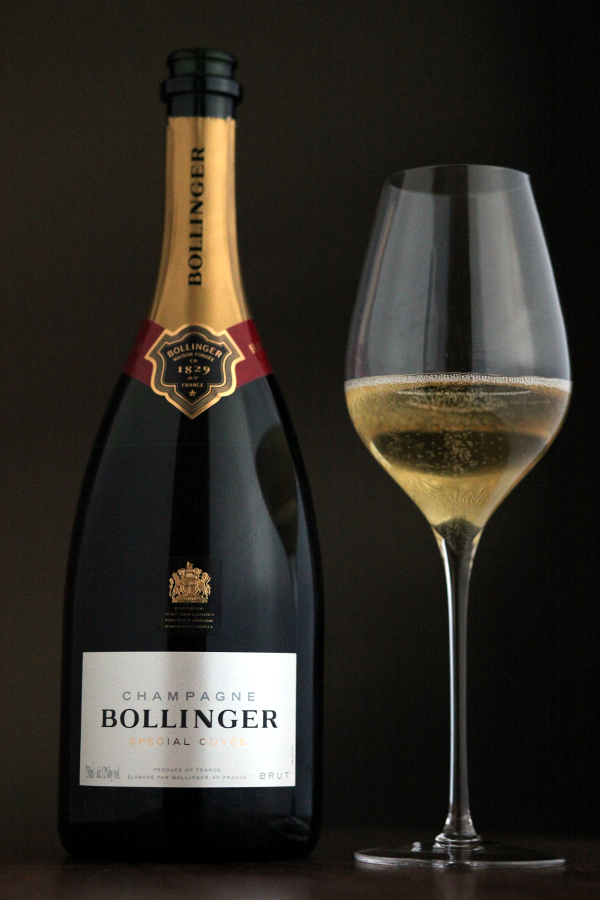 Special Cuvée. Stamped L1929607, hence this was disgorged on October 23 2019. Gorgeous photogenic bottle with a narrow neck that is super-comfortable to grip. Superbly executed bottle styling with the raised house font especially successful. Easy cork, followed by a whiff of the cellar. Vinous, with oak momentarily masquerading as passion fruit. Sweet but not heavy. Quite carbonated, even pointy. Full-flavored and a touch strong-headed. On the first night from Lehmann Lallement glass it tastes pleasant but the finish is not long and overall it feels slightly boring. Shows well the following day from Zalto White Wine glass, more nuanced, more interesting. Purchased at Gordon's in autumn 2020 for $55. ⭐
All photos and tasting notes are by @gaiwanstyle
Producer profiles and wine details are from books by Peter Liem (PL), Tyson Stelzer (TyS), and Tom Stevenson (ToS)
Producer profiles and wine details are from books by Peter Liem (PL), Tyson Stelzer (TyS), and Tom Stevenson (ToS)