Veuve ClicquotReims
Producer profile
PL Veuve Clicquot's name was Barbe-Nicole Ponsardin and she managed the house for forty years after her husband's death in 1805, "turning it into one of the most important in Champagne." Today it is "one of the most recognizable champagne brands in the world." Vintage Brut is "the real value" of the range. It is "blended from about twenty different grand cru and premier cru villages" and is a "rich, velvety champagne, channeling the puissance of pinot noir." "In contrast, Clicquot's prestige cuvée, La Grande Dame, focuses on subtlety." The goal of this wine is "to achieve the most delicate and elegant expression of pinot noir." With pinot noir as "the defining grape of the house", rosé is one of its strengths. NV Rosé is "accessible and harmonious" but the vintage "again represents real value", a "wine of bold flavor and gamy, spicy complexity." La Grande Dame Rosé with "particularly elegant and lacy pinot noir" from Clos Colin in Bouzy, is "vibrant and finely delineated." TyS 7/10 "characterful, full-bodied, pinot-focused wines." With "dizzying annual production", Clicquot is a "confident number two by volume behind Moët." The house employs huge oak foudres and "a battalion of barrels." "Barrel fermentation offers the chance to improve without changing the Clicquot style, to add some spice!" says Dominique Demarville, chef de cave since 2006. "With climate change, we are seeing vintages that are more and more diverse" so managing reserves is very important and vintages are not declared every year (recent vintages are: 2002, 2004, 2006, 2008, 2012, 2015, 2018). The house owns almost 400 hectares of vineyards, plus over 100 hectares owned by LVMH but this makes up only a quarter of the grapes used for production. The rest comes from over a thousand growers "with an average of less than one hectare each." Even though pinot noir leads every cuvée, the house still grows chardonnay in 50% of its own vineyards with "strong holdings" in Côte des Blancs. The house also sources from Côte des Bar. "My job during the harvest is to go all over Champagne and taste and smell what is different in every terroir, because every village is different from one year to the next." "Environmentally friendly sustainability will help us achieve a higher expression of terroir." Roederer's Lécaillon "names Veuve Clicquot as the other house that is moving fastest towards organics." Malo is blocked as needed, depending on the harvest, 10-15% in warm years. Oak foudres make up for the texture, bringing "complexity, creaminess and broad shoulders." Clicquot has "the biggest collection of reserve wines in Champagne besides Krug, currently comprised of 17 vintages." 450 different reserve wines are held and allocated in semi-annual tastings. Demarville moved to Laurent-Perrier (Salon, Delamotte) in 2020. ToS 91 "the vintages are the most exciting wines in the range."
PL Veuve Clicquot's name was Barbe-Nicole Ponsardin and she managed the house for forty years after her husband's death in 1805, "turning it into one of the most important in Champagne." Today it is "one of the most recognizable champagne brands in the world." Vintage Brut is "the real value" of the range. It is "blended from about twenty different grand cru and premier cru villages" and is a "rich, velvety champagne, channeling the puissance of pinot noir." "In contrast, Clicquot's prestige cuvée, La Grande Dame, focuses on subtlety." The goal of this wine is "to achieve the most delicate and elegant expression of pinot noir." With pinot noir as "the defining grape of the house", rosé is one of its strengths. NV Rosé is "accessible and harmonious" but the vintage "again represents real value", a "wine of bold flavor and gamy, spicy complexity." La Grande Dame Rosé with "particularly elegant and lacy pinot noir" from Clos Colin in Bouzy, is "vibrant and finely delineated." TyS 7/10 "characterful, full-bodied, pinot-focused wines." With "dizzying annual production", Clicquot is a "confident number two by volume behind Moët." The house employs huge oak foudres and "a battalion of barrels." "Barrel fermentation offers the chance to improve without changing the Clicquot style, to add some spice!" says Dominique Demarville, chef de cave since 2006. "With climate change, we are seeing vintages that are more and more diverse" so managing reserves is very important and vintages are not declared every year (recent vintages are: 2002, 2004, 2006, 2008, 2012, 2015, 2018). The house owns almost 400 hectares of vineyards, plus over 100 hectares owned by LVMH but this makes up only a quarter of the grapes used for production. The rest comes from over a thousand growers "with an average of less than one hectare each." Even though pinot noir leads every cuvée, the house still grows chardonnay in 50% of its own vineyards with "strong holdings" in Côte des Blancs. The house also sources from Côte des Bar. "My job during the harvest is to go all over Champagne and taste and smell what is different in every terroir, because every village is different from one year to the next." "Environmentally friendly sustainability will help us achieve a higher expression of terroir." Roederer's Lécaillon "names Veuve Clicquot as the other house that is moving fastest towards organics." Malo is blocked as needed, depending on the harvest, 10-15% in warm years. Oak foudres make up for the texture, bringing "complexity, creaminess and broad shoulders." Clicquot has "the biggest collection of reserve wines in Champagne besides Krug, currently comprised of 17 vintages." 450 different reserve wines are held and allocated in semi-annual tastings. Demarville moved to Laurent-Perrier (Salon, Delamotte) in 2020. ToS 91 "the vintages are the most exciting wines in the range."
Tasting notes
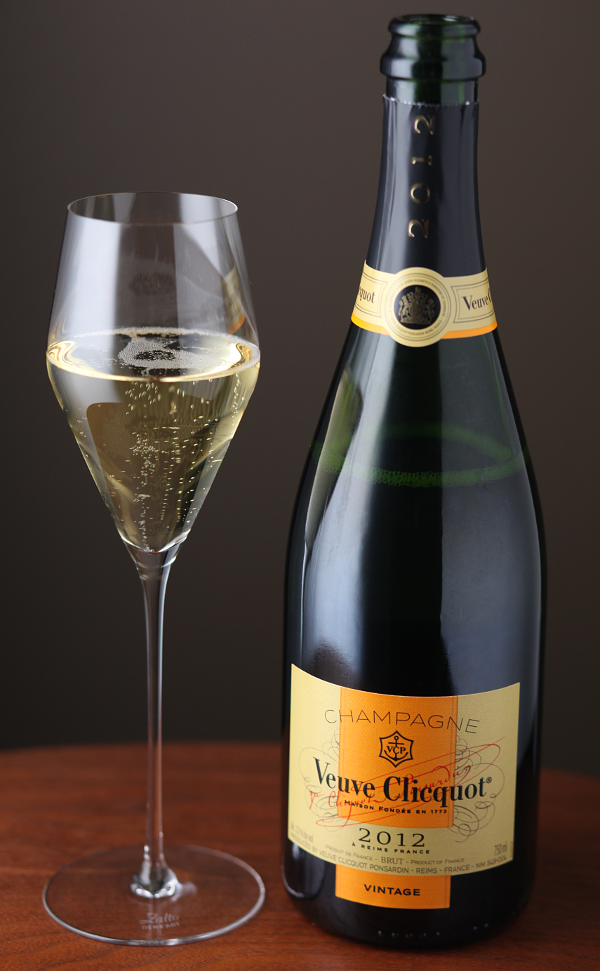 Vintage 2012. Disgorged November 2018. Came in a nice box. Uncorked with a festive pop. Pretty plaque de muselet with a picture of the widow. QR code on the back label leads to a page about 2008 vintage. I mean, how hard is it to get these things right? Very pale yellow wine, nearly transparent. Ebullient, light in body, even dainty, with a satisfying thirst-quenching quality and pleasantly bitter aromatics. Delicate and pretty but overall not terribly memorable. Apple and cucumber notes from Zalto Burgundy glass. Purchased at Applejack in autumn 2020 for $80. ⭐
All photos and tasting notes are by @gaiwanstyle
Producer profiles and wine details are from books by Peter Liem (PL), Tyson Stelzer (TyS), and Tom Stevenson (ToS)
Producer profiles and wine details are from books by Peter Liem (PL), Tyson Stelzer (TyS), and Tom Stevenson (ToS)